
me is non human
I you feel
feel feelings
feelings in my soul
soul in my heart
heart of the soil
soil is soft
soft as sun light
lights between
between the house and home
home in the imagination
imagination inside
inside beyond the borders
borders of the construct
constructs made up
up to my body
my body embodiment
embodiment is docile
docile as freedom
freedom is not the agency
agency of my capacity
capacity for my action
strategy of being
being in the wind
wind in my eyes eyes eyes
eyes look through me
through images thoughts
thoughts inside
inside representation
self representations
self self self
selfless being
non being non human
me me me
guilt shame
shameless non shame
between within love
love is fragile
fragile as me
as my memory
memory of present
present abstraction
abstraction of my art
art of my being
my being as a multiple people
people of non identity
beyond identity
identity free
free of freedom
freedom of choice
privileges constructed for white men
labeled as basic human rights
human rights are for human
me is non human
rightless speechless choiceless
lesser being lesser human
existence is my essence
men o’zi kimman, qayerda mening yo’lim
nedir maqsadim, orzuim
o’zbek qizi orzusi?
nedir o’zbeklik?
bo’lish, yashash, anglash,
tinchlik yoki ozodlik?
ozodlik faqat!
men bu tajriba, men bu hayot,
men bu gibrid, men bu yangilik,
men bu erta, men bu shamol, men bu osmon,
men bu nafas, sokinlik, kecha,
flexible is me, i’m done and tired,
i’m translocal, transregional,
non-human,
i’m no one, i’m everyone
i’m docile agent lost in between
subaltern speaks
i’m not religion, i’m not space, region, country, nationality
or either a nation
i’m what i’ve experienced, yashadim, bildim
bo’lishga haqqim bor
existence is my essence
i care, i cry, i feel, i try
dilimda tilaklarim bor
Introduction

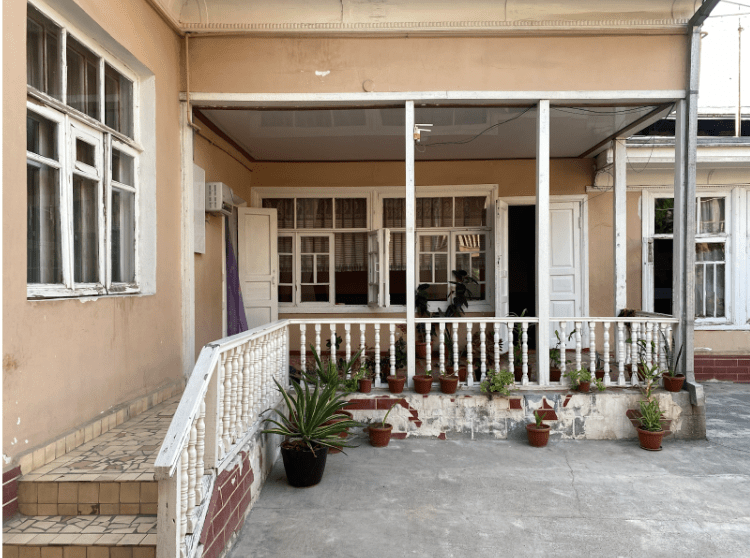
I am a 7 years old child, my mother left me at my grandmother’s home to make it easier for me to go to school and ensure that my grandmother wouldn’t be alone. The place is a lot different from my family’s home. They have a bathroom and hot water and tap water in the kitchen, but I do not feel myself home.
Every day, I follow the path from the gate down the long walkway. On my right, there is a wall painted by an artist, depicting scenes of oceans, palm trees, and blue skies, resembling a tropical country. At the end of the walkway, on my left, there are stairs that lead me into the ravon (hall) where my grandmother is usually reading the Qur’an, I just say “Assalomu alaykum” and go to my room to change clothes. Afterward, I go outside to water the plants since my grandmother loves them but sometimes forgets to water them. It’s already 5 am, which means it’s time to water and sweep the street outside our house as well as inside.
Returning to the house, I climb the stairs and enter through another door on the left. Inside, there is a long corridor — where my sister and I used to play a game where we closed all the doors in the other rooms, making the corridor pitch black, and then we would run towards each other, trying not to collide, although it wasn’t always possible. Along the corridor, there are doors leading to other rooms on the right and left. At the end of the corridor, there is my grandmother’s room with two beds, one for me and one for her. There are also several folded ko’rpachas lined up and covered with a blanket. The room carries my grandmother’s scent, a fragrance that reminds me patience and care. Stepping out of the room, I immediately notice a joynamoz (prayer rug) in the corridor where my grandmother performs her prayers. It means that I am not allowed to go outside and play with my friends: during Shom it’s not considered appropriate for girls to be outside. However, I am a stubborn child, so I run to the street to play games with my friends, knowing that my grandmother will probably be angry when I return. But I also know that I can hug her, and she will forgive me.
Intentions
Dard ah’lig’a ishq do’konini qursam o’ldurur,
Qurmasam o’lam,
If I build a castle of love [i.e., mystical knowledge] for the suffering people, they kill me!
If I don’t build I die!
(Uvaysiy 1980:58)
The research aims to question the idea of women being docile and oppressed by ‘traditions’ and religion — exploring our agency and resilience through dwelling into our daily and collective practices.
Drawing on Pakistani anthropologist Saba Mahmud’s ideas on agency – she suggests “thinking of agency as a capacity for action that historically specific relations of subordination enable and create”¹ developed in her study of the women’s mosque movement — and scholars in Central Asia, I will attempt to examine women’s collective cultural practices in the context of existing within the power matrix, both patriarchy and state anti-religious trends in Soviet and post-Soviet periods.
The urge comes from my own background as a woman being raised in a traditional Islamic family and having witnessed some of the practices and participated in them, unconsciously immersing myself into the community and cherishing Islamic identity. Growing up, I started questioning this identity and through reading liberal feminist texts I moved forward towards secular leftist ideas and feminism became an integral part of my newly found ‘identity’. During this period, I deliberately sought to find areas in religion that were difficult to explain in the face of liberal feminist thinking that posed women as docile and oppressed. Critics and arguments from my realized perspective were harshly turned down by my family, and led to an invisible crisis in our family relationship.
I think these difficulties arose from my reductionism about Islam and religion in general and its not being a part of the leftist world to which I tried to include myself. In our secular understanding, we often interpret religious truth as a form of influence, a dynamic of power that can be linked to economic and geopolitical interests. However, currently I am questioning these concepts and skeptically reviewing my own commitments, it is essential sometimes to doubt our firm belief, no matter how well-intentioned, that alternative forms of human ‘progress’ and life experiences are fundamentally less valid than the solutions we have under the “secular-left” political banner. We tend to believe in the universal vision uniting us and ignore that often the power system we might sympathize with has not led to global catastrophes.² However, this does not mean to cease to oppose injustices related to gender, ethnicity, class. It basically means that we have to try to self-criticize and skeptically review our commitments before starting analyzing the lives of those who may not share our ideologies.
Collective practices as a tool for self-preservation
During the period when Uzbekistan was a state within the USSR, there were attacks on Islam and Islamic institutions. Between 1927 and 1932, with the initiation of the ‘ideological front’ which made its goal to attack so-called ‘backwardness’, the political landscape of Central Asia significantly changed. Oppression towards intelligentsia, Muslim education and Islamic courts, taking away waqf property, closing mosques and shrines, and campaign against veiling starting in 1927 — Hujum.³ The party has admitted only their form of modernity and delegitimized other visions which were emerging inside the local (Islamist ) resistance groups and “intelligentsia” called Jadids.
It is interesting how women’s resilience took different forms, what were the methods and tools used — deliberately or/and unconsciously — as a means of self-preservation taking into account that most of them were considered so-called illiterate and most decisions on their life were made by men. The Bolshevik revolution intertwined women’s lives directly with the goal to “liberate” them through unveiling which was launched on 8 March 1927, International Working Women’s Day. The campaign was launched by the Soviet authority, and the accountability for the goal’s accomplishment was held by men in those women’s lives – husband, father, brother. Adeb Khalid described the severity of this campaign on men in his book “Making Uzbekistan” as follows: “As the campaign continued, the burden fell on male party members to liberate “their” women. The hujum became in many ways a site for the exercise of the power of men over women, often channeled through other men. In the village of Asaka, a meeting of the local union of cultural workers decided that whichever member unveiled his wife will have his name recorded on a board [krasnaia doska], while those who failed to do so will be expelled from the union (and from the party, if they were party members) and fired from their jobs…”. But those who were affected by the launch and paid terrifying prizes were unveiled women who soon became targets of harassment, violence, and encountered punitive shame in the face of their families and communities. Some of them faced tragic consequences — murder, rape, harassment.
Nevertheless, despite the fact that most of the women living in rural areas of the country were considered ‘uneducated’ (because they did not receive ‘modern’ education informed by the colonial class), they had their own knowledge systems to use against the hegemony praxis. Collective cultural practices, in which exclusively participated by women, were crucial in creating a sense of belonging and communication between women—transfering knowledge within and beyond. The practice of Suzana artistry was one site of this resilient knowledge production. Collectively sewing Suzana and transferring this knowledge to the next generation of women, these practices were the results of instruments of their struggles as means to validate and express their agency both collectively and individually through rituals, ceremonies and repetitive practices. Perhaps, these were their methods to show their complementarity with men and setting boundaries and limits to oppression and domination.⁴ With the added layer in which the colonial imperial class was limited in its ability to enter to the ichkari, or the inner sanctum of Central Asian families, commonly referred to them as the women’s quarters, in addition to their difficulty navigating traditionally Indigenous neighborhoods, mahallah, referring to them as “mazes” where they often found themselves lost and disoriented, highlights a limitation in entering women’s spaces let alone in witnessing women’s practices.⁵ Tsarist officials and their Soviet successors’ inability to unveil and thus transform the internal lives and practices of women informs a cultural preservation and agency for women in the face of generations of colonial and Imperialist cultracide via the cultural, collective, and domestic practices of Suzana artistry by Central Asian women.
If we look at Suzana embroidery practices through this paradigm, we might have seen it as a tool to embody resilience. The word ‘suzana’ comes from the Persian word for needle. The term is usually used for tapestry-like textiles that women collectively and/or individually embroidered mainly for a girl’s dowry or sarpa. Mothers start preparing their daughters’ sarpa starting at five or six years of age. The meaning of symbols within the Suzana and the overall picture it portrays is very broad and deep. In fact, while speaking about Suzana, we have to distinguish three different schools that are represented by three major historic cities: Buxoro, Samarqand, and Fergana, each of which has its unique style and meanings. But what unites them is that each has a soul and desires of women visualized symbolically.
One of the most important parts of the sarpa was the suzana. Sometimes the bride was taught by elderly women of the family embroidery so they can make suzana for their wedding. Women might use embroidery as a form of documenting their life in an acceptable form in that patriarchal system. As I am using the text, and if we imagine the textile as a paper, women could use their needle and stitches to build up their narrative. With every stitch, every time when the needle goes up and down, the story line is built that expresses a certain context of the family and tracks the time. The practice was done in women exclusive collective where women from mahalla (neighbourhood) gathered for ‘hashar’ (collective gathering of neighbors to assist with chores ) before the wedding to help to finish Suzani embroidery — this was an imaginative safe space where women could chat, dance, and express themselves. Shannon Ludington in her book “Embroidering Paradise: Suzanis As a Place of Creative Agency and Acculturation for Uzbek Women in 19th Century Bukhara” says “But this experience of embroidering was also a time of expression, which allowed for private thought and reflection while performing a culturally accepted act. Embroidering at its most basic level requires thousands of hand actions, or in other words, thousands of decisions. The embroiderer watches the fabric and decides in each instance where to bring the needle up, where to put it back down. This repetition and decisions, allows the embroiderer a sense of agency over their lives…”⁶
In my family my great-grandmother made a dowry suzana for all her granddaughters, her being the last Suzana master in our women lineage. She made a suzana for bed hanging and a couple of joynamoz which my mother saved for my dowry. Although, I convinced my mother to give it to me before my marriage and I use it as a wall hanging. When I look at my suzana, it reminds me of how valuable family heritage is as well as the importance of passing stories and knowledge from one generation to the next. Ludington continued describing “They, and contemporary authors, were considering a literacy based education that included arithmetic and geography, while what children were receiving was a life based education. Previously, mothers passed embroidery skills on to their daughters, but today, they more commonly pass on suzanis.”⁶ The suzani itself is made in Ferghana valley style: colorful, pink textile with flower patterns and it is embroidered with tulip, rosette ornaments.

Suzani also used to build the marriage domestic space after the bride ‘migrates’ from her parents’ home to her husband’s. It can be used to divide and decorate the couple’s room in the form of wall or bed hangings, table cloths, and blankets. This trousseau that the bride brings with her can be used to make the ‘foreign’ space to feel safe and home. As Ludington highlighted “They not only played key roles in the education and marriage of the girls, but in their married lives to come.”⁶ The specific placing of suzani could give a meaning and function of the place: if it is used as a cover for blankets, the place automatically turns into a bedroom area, if it is hung decoratively on the wall it could make the place a space for welcoming the guests. By these practices the bride may gain autonomy in the home, decide the functionality and what the certain area is designed for — this was a way to build their self-organized space and become an embodiment of their agency.
Angela Izrailova highlights the intricacies of the use of Suzanas in the home in their text Suzani Vernacular: Technique and Design in the Central Asian Dowry Embroideries:“ In the old times this large piece was displayed at the wedding and then used to drape the walls of the bride’s new home. It was always placed on the wall opposite the entrance door, so that the guests saw the most dramatic piece (of size, color and design) as soon as they entered the house. This tradition was passed on into the twentieth century, although these valuable possessions were now used to decorate the walls only during the first year of marriage, or until the first child was born.”⁷
Domestic space and agency embodiment


If we look into work “Self Reflection and the Self. In Rewriting the Self: Histories from the Renaissance to the Present” by Gregory Starett we can explore the essence of performance of some religious rituals through Bourdieu’s notion of habitus and body hexis.⁸ According to Bourdieu hexis and habitus can be understood by unconscious practices which do not involve explicit discourse. According to Starrett, issues of bodily hexis-what he terms “embodiment of ideology in habit”–may be best understood “as a set of processes through which individuals and groups consciously ascribe meaning to … bodily disposition, and establish, maintain, and contest publicly its …valence”.⁹
Through self-discipline it is possible to analyze and emphasize how through self-directed actions we might acquire a certain way of being and behaving. While examining the process of obtaining the habitus it is essential to consider Mahmood’s ideas on “historically and culturally specific embodied capacities that different conceptions of the subject require.¹⁰ How our body relates to ourselves and others changes depends on various power systems. The reason is our bodily rituals can navigate and provide the capacity for an interaction with the world.
If we look at bodily practices and rituals that happen in the domestic space, where women have spent most of the time, freely expressing themselves. We might recognize how repetitive acts become an integral part of being and one can unconsciously use their body as well as the space to represent themselves. Some of the mundane and invisible everyday practices — cooking, cleaning, praying, stitching and decorating the house — can be considered as malaka – “Malaka, therefore, is an acquired excellence at a moral or practical craft, learned through repeated practice until that practice leaves a permanent mark on the character of the person. What is notable in this formulation is the way inward dispositions (emotions, intentions, desires, etc.) are understood to articulate with visible behaviors (gestures, speech, bodily motions, etc.), and the two are made to synchronize in accord with a specific model of exemplary behavior.¹⁰
In this sense I will try to study and visualize the rooms, practices and our behavior within these constraints. Domestic space can be reviewed as a ‘mosque’ for women for whom it is often not permissible to enter the real one, (as in the context of Central Asia women are not expected and allowed to enter the mosque) so it migrated to their homes — where they can perform their Namoz (prayer), hold ehson (gathering to express the gratitude to God and to close ones), gap (ritual gathering, that replace the social network). Fluidity of the house makes it robust and easy to transform: the house where my parents live became an imaginative performance space — when you enter the home the first thing you see is clock with verses from Quran, on your left there will be obdasta (pitcher) where youngest member of the family waits you to pour the water to your hand, if it is men’s gathering, then the kitchen became an escape room for women in the family, on the door to the toilet you will catch the prayer to read before to go in then entering the bathroom there is a prayer and algorithmic instruction to read while you are cutting your nails. It was also transformed situationally; depending on the occasion a room in an individual dwelling could be re-defined in terms of its function. One’s mehmonxona (living room) could be defined as a study room, as an eating area during iftor (breaking of the fast), or as a sacred place during an evening prayer or religious ceremony. “These transformations manifested the multivocality of domestic space, illustrating various meanings that it had for its inhabitants and visitors.”¹¹ Women in our family — my mother and grandmother — consider their room as a holy space where they perform their prayers, read Qur’an, I can notice how their bodies change in the process, it becomes both solid and soft, both docile and resilient.
“The multilocality of the place was exemplified by these qualitative shifts in individual behavior, which in turn signaled a qualitative transformation of space into a sacred place, a different public place.”¹¹
Common use of the domestic space for religious ritual can be witnessed in Otin-Oys house, who are believed to be ‘sacred’ and ‘healing-mother’. When I was a child in our Mahalla there was Otin-oyi whom we visited when there were family troubles— when someone was applying for university or when we hoped to become closer to God. We usually left water and something edible in the room where otin-oyi would perform prayers that sounded like music. After these ceremonial events all belongings that physically had taken part in the ceremony were considered to be sacred as well and when you consume some of these products it can have a healing effect on your body and soul and can lead you down the correct path.
“Otin-Oys are expected to be supporters and transformers of the present life (healers, diviners) who have extra power extending to another world. For example, mourning rituals are considered to be patterns of “transmission time,” bridging this and another world. At funeral ceremonies I attended in Bukhara, relatives and friends of the deceased person wore photographs and pictures of their recently deceased family members on their turban (or headscarf) to send a message to another world through the singing of the Otin-Oy who thus acts as a guide between this and other worlds.”¹²
References Cited
[1] Mahmood, Saba. Feminist Theory, Embodiment, and the Docile Agent: Some Reflections on the Egyptian Islamic Revival. Cultural Anthropology, Vol. 16, No. 2 (May, 2001), pp. 202-236.
[2] Mahmood, Saba. Politics of Piety: The Islamic Revival and the Feminist Subject. REV-Revised, Princeton University Press, 2005. JSTOR, https://doi.org/10.2307/j.ctvct00cf.
[3]Making Uzbekistan: Nation, Empire, and Revolution in the Early USSR. Cornell University Press, 2015. Khalid, Adeeb.
[4] Boddy, Janice. The Legitimacy of the Modern Age. Cambridge, MA: MIT Press, 1985.
[5] Paul Stronski, Tashkent: Forging a Soviet City 1930-1966.( Pittsburgh,PA.:Univerity of Pittsburgh Press, 2010), pp 23-28.
[6] Ludington, Shannon. Embroidering Paradise: Suzanis As a Place of Creative Agency and Acculturation for Uzbek Women in 19th Century Bukhara. University of Nebraska – Lincoln DigitalCommons@University of Nebraska – Lincoln, 1985.
[7] Izrailova, Angela. Suzani Vernacular: Technique and Design in the Central Asian Dowry Embroideries. DigitalCommons@University of Nebraska – Lincoln, 1998.
[8] Bourdieu, Pierre. Political Language and Oratory in Traditional Societies. New York: Academic Press, 1975.
[9] Starrett, Gregory. Self Reflection and the Self. In Rewriting the Self: Histories from the Renaissance to the Present, 1997. Roy Porter, ed. Pp. 49-60. New York: Routledge.
[10] Mahmood, Saba. Rehearsed Spontaneity and the Conventionality of Ritual: Disciplines of “Ṣalāt”. American Ethnologist, Vol. 28, No. 4 (Nov., 2001), pp. 827-853.
[11] Peshkova, Svetlana. Bringing the mosque home and talking politics: women, domestic space, and the state in the Ferghana Valley (Uzbekistan). Springer Science + Business Media B.V. 2009.
[12] Sultanova, Razia. Female Celebrations In Uzbekistan And Afghanistan: The Power Of Cosmology In Musical Rites. 2008 YEARBOOK FOR TRADITIONAL MUSIC Volume 40.
 maqaal